Tuesday, March 27, 2012

My Senior Design Project Warnings and Disclaimers

PAHU Integrated Security Usage and Caution


How Device Can Be Used Incorrectly

  • In our project, we have both a physical component as well as the software to go with that physical component
    • Not knowing how to use the physical component.
      • User may not read the manual or documentation with the physical component because reading it takes time which the user does not have or does not want to do.
      • In the process, the user becomes curious about using the device and instead of using it together, like it is supposed to be used. The user takes the physical component apart and decides to use just the camera.
    • Camera could not be pointed at a valuable area to the user, which in turn would cause the camera to capture and monitor everything that is not important.
    • Another reason the camera can be misused is if the camera records or captures images of people or a place that isn't lawful, so make the user aware to always ask people when capturing them on video or place a sign in the room letting he/she know that the room in which they are in is under video surveillance.
    • Another obvious reason is the electrical hazard of using the physical device. Plugging it in incorrectly could lead the user to shock themselves.
    • Do not let small children operate the camera or the software on his/her computer without adult supervision.
    • Make the user aware of all responsibilities  and state laws he/she might have to deal with if unlawful activity is ever recorded with the camera.
    • Another obvious reason would be setting up the camera incorrectly. PAHU Team will provide the user with a quick install manual. However all users need to follow this guide.
Images of Warnings For Potential PAHU Integrated Security
Electrical Hazard
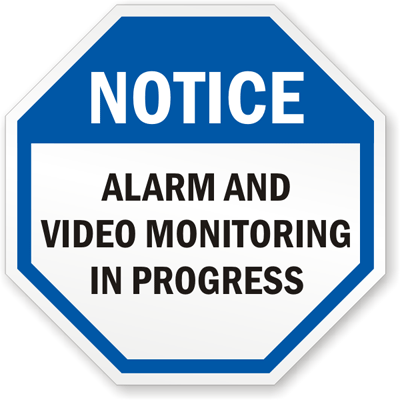
Tell people that you are monitoring the room they are entering.


Small children should always use PAHU Integrated Security with adult supervision.


Do not let small children play with PAHU Integrated Security, especially the physical component.


Use for additional types of warning for the user.


Disclaimers For Potential PAHU Integrated Security
Disclaimer to tell user not to user the camera for anything unlawful.


Allows user to record a room without getting sued.

Disclaimer
I am not responsible for any bodily harm as a result of using my creation (camera or GUI) including but not limiting electrical hazard from my creation or any type of physical injury due to construction malfunctions.

This disclaimer cautions the user to handle with care as the creator of the product is not responsible for any physical harm cause to the user.

Disclaimers or Warnings For PAHU Integrated Security

Disclaimer
I am not responsible for any bodily harm as a result of using my creation (camera or GUI) including but not limiting electrical hazard from my creation or any type of physical injury due to construction malfunctions.

Caution
Safety First!

Caution
Parent/Adult supervision is advised when a child is using this device.

Disclaimer
Please be aware of the electrical hazard that can be brought with this device. I am not responsible for any physical or mental harm caused by device. Please use caution when operating with this device. Please follow the instruction and be sure to make yourself aware of the danger with this device.


I have spent 2 hours on this assignment.


Monday, March 5, 2012

Design of Design: Chapter 16

Chapter 16: Representing Designs' Trajectories and Rationales

  • Introduction
  • Linearizing the Web of Knowledge
  • Our Capture of Design Trajectory
  • Our Process for Studying the House Design Process
    • What is a Design Tree?
  • Insights into the Design Process
    • Design Isn't Just To Satisfy Requirements, but Also to Uncover Requirements
    • Design Isn't Simply Selecting from Alternatives, but Also Realizing Their Existence
    • The Tree Changes as the Design Changes -- How to Represent That Evolution?
  • Tree of Decision Versus Tree of Designs
  • Modular versus Tightly Integrated Designs
  • Compendium and Alternative Tools
    • Task Architect
    • Project Management Tools
    • IBIS and Its Descendants
    • Compendium
  • DRed - A Tantalizing Tool
I have spent 2 hours on this assignment.


Sunday, March 4, 2012

Patents


          This patents is closely related to our project. For our project, we are designing hardware that will allow its user to use the hardware with low power and image compression with a software suite that will allow them to interact with the video contents. The patent refers to almost the same thing. The inventors are created some sort of hardware with their software suite which is supposed to be interactive. However it doesn't specify in the patent document if the hardware aspect will have low power or image compression, but the patent document has several points that we haven't talked about as a group.


Integrated Security System And Method

        This patent is not as closely related to our project as the above patent. However, it seems our project is similar in the way the compressing of the video works. In this patent, in the hardware, it seems that they are also somehow encoding and decoding video information for its users. Their software, meaning what displays in the video feed, is not as interactive as what we were hoping to accomplish in our project.


Tuesday, February 28, 2012

Design of Design - Summary of Chapter 15

Chapter 15: The Divorce of Design
  • The Divorce of Design from Use and from Implementation
    • Most appalling development in the design disciple in the 20th century has to be divorce of both the user and the implementer.
    • Several designers back in the 19th century and onwards have invented significant amount of things.
    • However designers can rarely use their own personal experiences as a user, and must seek advice from other.
    • There are exceptions to the divorces, and one exception is software engineering.
    • "Software engineering, for example, is still so young that system architects were once programmers" (Brooks, 176).
    • "The designers of UNIX and especially the Open Source designers of Linux start with their own needs, build tools for their own use, and share with their own peers. I reckon this accounts for both the use success and the user passion" (Brooks 177).
  • Why the Divorces?
    • Advances in the 20th century required specialization and attention from special engineers and in specified time. The implementation was critical in specialization.
    • Some things designed are much more complex and demand a lot of energy from the designer, as well as the cases mentioned above about time and specialization.
  • Fallout from the Divorces
    • Most divorces happen due to miscommunications.
    • "Architects build elegant buildings that are hard to work in" (Brooks, 177).
    • Sometimes communication is poor which can prevent the engineers in knowing exactly what is needed.
  • Remedies
    • Remedy 1: Use-Scenario Experience
      • A small amount of experience is better than not having any.
      • "This “user” experience led to the design of the first operator’s console to be program-controlled (essentially a close-connected terminal) rather than directly reflecting and affecting the hardware, a capability that enables multiple consoles for multiple operators, and a flexible allocation of tasks among operators, as well as online interactive debugging of programs" (Brooks, 178).
    • Remedy 2: Close Interaction with Users via Incremental Development and Iterative Delivery

    • Remedy 3: Concurrent Engineering
    • Remedy 4: Education of Designers

Knoxville Businesses


  • Located on 1212 Galewood Rd, Knoxville, TN 37919
  • Video Security Systems is a private-based company which is classified under Fire Alarm Systems and Equipment Testing. This company also provides services in burglar alarm systems.
  • Established in 1989.
  • Employes around 1 to 4 people.
  • 22 years in business.
  • Annual revenue is $1 to $2.5 million.
  • Call (865)693-8060


  • Located at 309 David Street, Clinton, TN.
  • ITS Home Security installs and services major brand of security systems in the surrounding area of East TN. Some of the brands that ITS Home Security services include Ademco, DSC, Honeywell, and Caddex.
  • Established in 2008.
  • Employes around 1 to 4 people.
  • Annual revenue is $1 to $2.5 million.
  • Email sent to ITS Home security at info@tnalarms.com

  • Located on 10629 Lone Star Way, Knoxville, TN 37932
  • Liberty Security Systems is a locally owned business, serving the security needs of people residing in Knoxville, TN.
  • This company services several needs:
    • Burglar alarms
    • Security systems
    • Home theater such as surround sound
    • Fire alarms
    • Smoke detectors
    • Heat detectors
    • Gas detectors
    • and more.
  • Established around 1986.
  • Employes around 2 to 4 people.
  • How much revenue does the business generate? PENDING
  • Email sent to Liberty Security Systems at info@libertysecuritysystems.com

Monday, February 27, 2012

Addtional New Technology

New Battery Technology


Engineers at Northwestern University have been using the new lithium-ion technology which allows a user to expand their battery life 10x.


"Dr. Harold Kung of Northwestern University said they are able to make all of this possible because they discovered how to squeeze more ions into the battery and increase their movement speed. With the new technology, a typical mobile phone would charge to 100 percent in only 15 minutes, yet last for an entire week on that single charge" (Tinari).


Kung says that even after 150 charges, meaning being used for one year or more in operation Kung believes the battery is still more effective than a normal lithium-ion batteries nowadays.

Thursday, February 23, 2012

Design of Design - Summary of Chapters 13 - 14

Chapter 13: Exemplars in Design

  • Few Designs Are All-New
    • But These Surely Are Fun!
      • Rarely does a designer see a design that is completely new.
    • The Common Lot.
      • Most designers derive from found facts that are intended for similar purposes and built with the same technology.
  • The Role of Exemplars
    • "Exemplars provide safe models for new designs, implicit checklists of design tasks, warning of potential mistakes, and launching pads for radical new designs" (Brooks, 154).
    • That's why great designers took the time to find and understand what has already been discovered by others.
  • What about Computer and Software Design?
    • A great design follows older design disciplines, but nowadays we have improved greatly in learning the new ways of the modern science.
    • What Exemplars Do You Use?
      • Computers.
        • Designs adapt well in a common field.
        • Hence people who work for a certain company, can do a better job designing something for that company because he/she knows better how to make their design adjust with the company and adapt with it well.
      • Mass-Product Software
        • "Products such as Microsoft Word have followed the design pattern of computers, with successive generations created by progressively modifying function an implementation" (Brooks, 156).
      • Custom Application Software and Operating Systems.
        • The building and architecture of software solely relies on the experience of the designer instead of the individual themselves. Each person deals with certain tasks depending on what they are good at, and what they feel comfortable knowing.
  • Studying Design Rationales of Exemplars
    • To overview about a product, the designer has the studying the technical papers and other books about the product.
    • Technical papers emphasize what the product and sometime goes over the why of the paper.
    • First-Generation Computers
      • " The most important computer paper ever written is "Preliminary discussion of the logical design of an electronic computing instrument""(Brooks, 157).
      • After many designers read this paper, many designer tried to successfully build a store-program computer.
    • Third-Generation Computers
      • "Second-generation computer architectures ran out of gas; that is, they lacked enough address bits to handle the large memories that had become economical and indispensable" (Brooks, 158).
      • High level language allowed for recompilation and integrated circuits provided a great deal of insight in their realization cost.
    • Virtual Memory
      • "The Manchester Atlas introduced the automatic paging of blocks instructions and data from a slower backing store into a smaller high-speed memory" (Brooks, 159).
    • The Minicomputer Revolution
      • Transistor-diode logic changed the way computer where made. It drastically made it cheaper to think about a computer.
    • The Microcomputer and RISC Revolutions
      • With integrated circuits,  a revolution took place making it cheaper for individuals to own a personal computer/machine.

  • What Should a Discipline Do to Improve Exemplar-Based Design?
    • Collection of Exemplars
      • This section show that there are plenty on exemplar designers.
    • Beyond Collection
      • After carefully overviewing the collection, all you have to deal with is an even-handed criticism for each particular exemplar.
      • Next step after criticism would be analysis.
    • What about Software Design?
      • Software design has been developed and improved for a long time, that's why it has progress so much thought collections, criticisms, and analysis.
      • Who?
        • "Systematizing exemplars for study is a task of scholar- ship, not of design. Scholars and designers are different in taste and temperament" (Brooks, 161).
      • How Encouraged?
        • "Does modern engineering academia value and praise the work of the systematizer? Can one get tenure for doing such? In many institutions this work would be valued in a History of Science and Technology Department, but not in an Engineering Department" (Brooks. 161).
  • Exemplars -- Laziness, Originality, and Pride.
    • "Whoa! The above discussion on exemplars in design skips lightly by some issues very real for each designer:
      • Isn’t copying an early design, a precedent, just an exercise in laziness? Can an honest professional do that with integrity?
      • People become designers because they like to make things. What fun is there in confining one’s self-expression within the iron cage of another’s style?
      • The world highly values originality and innovation and rewards them with respect, reputation, and sometimes fame and fortune.
      • One’s special contribution to the human race depends upon one’s own unique vision. Isn’t it a disservice to neglect or suppress this originality?" (Brooks, 162).
    • Some Perspective
      • Brooks does not assert that exemplars who have adapted to the design can easily solve most design problems.
      • However Brooks does assert that:
        • The designer should know well the exemplars of his craft, their strengths, their weaknesses. originality is no excuse for ignorance.
        • In engineering, if not in the arts, gratuitous innovation (that is, not anticipated to be “better” in some useful sense) is a foolish idea and a selfish indulgence of pride—because of the unavoidable risk of unintended downside consequences.
        • Designers who master the styles of their predecessors have more treasures upon which their originality can draw.
    • Laziness
      • The world is full of lazy designers who hardly do any work. These lazy designers can minimize work, instead of picking an exemplar and modifying it to fit.
      • However most lazy designers just copy the work and do not draw any conclusion that someone who isn't lazy can. 
      • For instance, the ancient designers who have become exemplar over the years.
    • Originality and Pride
      • Designers try to meet their functional needs and make sure that their design is robust, and durable under stress.
      • Originality as Goal or By-product.
        • "He who seeks originality is apt to find novelty, but not permanence of delight. On the other hand, he who seeks to make designs that really work is most apt to come up with new designs of enduring value, almost as a by-product" (Brooks, 163).
      • Pride.
        • "Closely tied to the striving after originality is pride, a desire to make a name for oneself. This ancient cause and consequent of humanity’s fall infects all design, and ruins much" (Brooks, 163).
Chapter 14: How Expert Designers Go Wrong
  • Mistakes
    • Brooks believes that a designer with less experience tends to make mistakes that a professional person would not make.
    • However when professionals make mistakes, it is normally a large mistake.
    • Sometimes it can affect the construction on the product.
    • Henry Petroski lists a few of things that designers do regardless of experience.
      • Tread cautiously at first.
      • Master the new approach.
      • Begin to extend it boldly, often forgetting the underlying assumptions.
      • Overreach in their boldness and self-confidence, pressed perhaps by hubris and competitiveness.
    • "Success is dangerous for the professional designer. Failure stimulates analysis, scrutiny, rethinking. Success stimulates confidence both in design technique and in oneself. Both trusts may be misplaced" (Brooks, 169).
  • The Worse Computer Language Ever
    • Brooks explains that one failure caused by experts has to be IBM's Operating System / 360 Job Control Language (JCL).
    • What's JCL?
      • OS / 360 was designed to be a batch operating system, however the first terminal users could interact with each other by sending job into the queue, setting them up, inquiring its status, and results of the jobs done.
      • JCL was a scripting language that specified the options for computer a batch job.
    • So What's Wrong with JCL?
      • "The biggest flaw of all was that JCL is indeed a programming language, but it was not perceived as such by its designers" (Brooks, 170).
      • One Scheduling Language for All Programming Languages.
        • Each user of the OS/360 concept must know at least two languages, one of these required languages was JCL, then the second could be any language of his choice.
        • Designers wanted schedule-capability instead of a single schedule-time language.
      • Like S/360 Assembler in Syntax, Rather than a High-Level Language.
        • "Having mistakenly decided to have one schedule-time language, the designers chose the wrong one. As early as 1966, one year after the full OS/360 was up and running, assembler- language jobs accounted for only about 1 percent of all jobs. A major paradigm shift had happened, and it wasn’t recognized" (Brooks, 170).
      • But Not Exactly Like S/360 Assembler Syntax.
        • "Enough deviations crept into JCL that knowing S/360 Assembler syntax did not mean knowing JCL syntax (Brooks, 170).
      • Card-Column-Dependent.
        • A paradigm was taking place, and being pushed, however, the system wasn't recognizing it.
        • "Fortran, for reasons having to do with the 36-bit word of the IBM 704 (1956), allowed statements of 72 characters, plus continuation lines. Characters beyond the 72nd in a line were ignored" (Brooks, 171).
      • Too Few Verbs.
        • "The designers’ proud boast was that JCL has only six verbs: JoB, EXEC, DD, and so on. And so it does. But the number of functions the language has to perform far exceeds six.2 With an imposed “elegant” simplicity not up to the actual complexity inherent in the task at hand, the complexity inevitably breaks out in jury-rigged solutions" (Brooks, 171).
      • Declaration Parameters Do Verbish Things.
        • "The verb functions have to be provided somehow. So in JCL a Data Declaration (DD) statement is provided with a (too-)rich set of keyword parameters. Many of these are imperative verbs in disguise, such as DISP, which commands what to do with the dataset after a job step ends" (Brooks, 171).
      • Almost No Branching.
        • "Central to most programming languages is the concept of a conditional branch. JCL has no such central concept—branching is an afterthought, restricted in action, achieved through a parameter" (Brooks, 171).
      • No Iteration.
        • "There is no direct primitive in JCL to accomplish iteration; it must be fashioned out of the awkward branching. The designers did not imagine an iterative action in a schedule- time script" (Brooks, 171).
      • No Clean Subroutine Call.
        • "Similarly, the designers did not perceive any need for a subroutine call in a schedule-time script. This is harder to understand, for many JCL programs make extensive use of open subroutines, that is, repeated sequences of commands identical except for a few parameters" (Brooks, 171).
    • How Did JCL Get That Way?
      • Designers who worked on this language brought too much experience into the task, hence users like us who don't have much experience tend to not want to learn JCL.
      • "Few types of control cards did indeed characterize the 1410/7010 operating system, and fewness equated to simplicity as a goal for oS/360 JCL. This led to having too few verb types. Not only was fewness of card types wrong; so was the implicit assumption that each job would be controlled by a few cards of each type. In the event, JCL scripts usually contained dozens of statements" (Brooks, 172).
      • One problem discovered was that most designers believed that JCL was nerver really designed. If the designers who designed it had thought of it as a language, then perhaps there was hope.
I have spent 2 hours on this assignment.